
(C) 2003 Hank Wallace
Whenever I talk to an engineer or technician about my job as an independent designer I see them float off into a dream sequence wondering if they could possibly pull off such a job switch. They look at me as if I have some special gene. When I tell them that I did not exactly plan my career switch to independent contractor, that I just quit my real job out of frustration, they really get swimmy headed. This seems to be a dream of many techies. Also, given the number of axed engineers, there is certainly a need for information about going independent.
The purpose of this article is to provide one person’s viewpoint on that process. If you desire to exit the monolithic, faceless corporate world, or if you have been kicked out due to someone else’s mismanagement read on. (However, for legal or accounting advice, please consult the appropriate licensed professional.)
Who Hires Us?
Let’s assume that you have made the leap to independence. You are on your own, but you still have to eat! That means getting work from an individual or company who needs your services. Who are these people?
The first group are pressured managers in large companies. These people are faced with dwindling staffs and increasing performance expectations. Do more with less. That is where you come in. Your pay can be ‘expensed.’ That means that you are easier on the accountants and the corporate tax effects are lightened. Congratulations, you have become an appliance.
That is the draw with large companies. They can hire and fire contractors at will without any commitment or conscience, though they often treat full-time employees the same.
Big company middle managers are seldom looking for more than someone to solve the current problem. The next problem has not been defined yet, and even if it has, management will likely change horses and problems in midstream. So, nothing ever happens until it happens. This means that you will have to roll with the punches as the project develops, the schedule shrinks, and the sales people promise more features than can fit into the ROM.
Large organizations also frequently move their people, and people hop between megacorps easily. This creates a disappearing contact problem where you work closely with a group of people on a project for an extended period of time, then six months after the project is over you find that all those people have been promoted, fired, or have quit. This makes cultivation of references in large companies difficult.
Working in a large company situation can be frustrating, but the upside is the possibility of extended work. Large companies generally pay their bills, and pay on time, so you exchange payment security for on-the-job hassle. It’s your choice.
At the other end of the range is the small company with a small budget. These companies cannot afford to hire additional (or any) engineers for the current project, so they opt to shop the work out. The considerations are mostly complementary of the large company situation. Small companies generally have less working cash, but have better vision and the environment is more personal and exciting. What you do matters, and the success of the entire company can hinge on your efforts. Getting paid can be difficult, though, depending on management competence and integrity. And while large companies frequently cancel entire projects and cut the staff, small companies frequently go out of business altogether.
I personally like the small venue because what I do matters. I have worked on some projects for large concerns which were cancelled, taking a thousand hours of work down the toilet with not a second thought. That is very ungratifying.
Marketing Yourself
Having decided what type of environment you desire to work in, you need to market yourself. There are several ways to do this.
The first tool at your disposal is the resume. I will not go into this in detail because there are so many excellent sources for resume advice, probably too many. However, I will say that, contrary to popular belief, I like to see as much detail on a resume as possible, especially for an engineer. I want to know exactly what the person has done, when, and how long. I want to see results, not just that he “developed analog circuits.” I can trash the resume at any time, so I am not concerned whether it is one, two, or five pages long. I have never seen a one page resume for anyone who I would consider hiring; if you can painlessly fit it all on one page, you likely do not have enough experience to be valuable (but there are exceptions).
These days, your resume can easily be added to one of several online databases which companies search when they need help. Most are free. And of course, listing your qualifications on your own web page should not be overlooked.
Advertising is the next thing to consider, but it of course requires money. Mailings, magazine ads, and paid Internet ads are some of the options. Visit your local library for information on writing a good ad, or call the publication you are considering for some ideas.
When advertising, there are several points you should get across:
- What you do. Yes, I read ads which give no hint of the services or products offered.
- Your work philosophy. Are you a big project type? Are you a hero who works in high pressure situations to save the day? Are you a DSP geek?
- Economics. Are you affordable? Or is your service in such demand that you need not mention how expensive you are?
- Special enticements. Free initial consultation. Discounts on long term work. Warranties.
- Why should that overworked middle manager who fears his own impending sacking hire you?
In any case, your ad should look professionally done. Do not create ‘camera ready’ art on a dot matrix printer and expect to impress anyone. Any publication worth advertising in can help with layout, sometimes for no additional charge.
And when your ad runs, be sure that you are there to answer inquiries. Don’t delegate that job to your voice mail system. If I call a business to inquire about their service and get dumped into voice mail, I never call back because that is likely indicative of their service overall.
When marketing yourself, you also have to choose your territory. If you advertise in a national publication (or on the Internet), be prepared to travel. Some companies will expect you to travel at your own expense to kick off a job, so be sure you are explicit about expense billings before you go. For regional coverage, some publications offer geographically targeted inserts or mailing lists by state or zip code. If you are seeking Cobol work on mainframes (gag), be prepared to relocate to the site of the system. Much embedded system work, however, can be performed in your lab. You must decide where you want to work before you place the ad.
And don’t forget the advantages to hiring an independent contractor. There are no benefits paid, you work only as needed, you are detached from corporate politics, accounting is simplified, and there is generally less overhead associated with a contractor. Contractors may be used as needed and expect to be let go at the end of the job. Some managers do not consider these things, so it is good to point them out in the appropriate situation.
Unfortunately, many consultants neglect the importance of word of mouth advertising. Be smart and ask for referrals. It teaches your clients to be on the lookout for more work as well, if you are not fully loaded. And this form of advertising is free and very effective, resulting in a personal reference before you ever talk to the prospective client.
Business
If you are running your own business, you MUST know something about business. Engineers who are above dirty, boring business details are sure to end up broke.
You should bone up on basic accounting and elementary business law before you start your business. Your local library can get you started, or ask a friend for some book recommendations. The following sections detail some of the important business considerations.
Accounting
Whenever you earn money, the government wants a cut of the action. Give them too much and they never give it back. Give them too little and they take the rest. This is where accounting comes in.
The best advice I can give you is to talk to a CPA before you write your first invoice. Get a bookkeeping system set up and follow it religiously. Do not use a shoe box with the hope that a convenience store tax preparer will be able to sort it all out just before your tax return is due.
Along those lines, you must keep good records. Keep absolutely every check stub, cancelled check, and receipt that you touch. Copy every check before deposit to defend your income figures. Don’t every throw away any business documents or records, financial or otherwise. As a small business, these records will not consume much space, and you may need them if things turn ugly.
My accountant is one of my closest advisors. I consult my CPA before every major move, and it has saved me money and grief as a result. Don’t skimp on a CPA. Don’t use your brother-in-law who took an IRS tax preparation class a couple years ago. Don’t ever consult with someone for professional advice who you would not hesitate to sue if they do you wrong!
Insurance
No one like buying insurance. And business insurance is expensive. However, it is a necessary evil for the likes of us. Any competent insurance broker can help you insure your business adequately, including liability, theft, fire, and other types as needed. However, READ YOUR POLICY, because some brokers sell policies labeled as small business insurance that do not include basic coverage, such as theft!
Another form of insurance is backing up your software and creative works in a secure off-site location. A bank safe-box is a good bet, but other locations may work as well, depending on your situation. My rule is that I always back up every source file I changed on the computer before turning it off for the day.
Credit
Many consultants ignore this aspect of the business. Establishing credit is very important, even if you do not routinely purchase inventory for use in your business. If you write software for a living, for example, you may only purchase small amounts of computer supplies. In that case, open an account with an office products outlet and purchase on open account. That way, when you need the trade references, you will have established some record. The trick is to start small and build from there.
After a few years of such meager activity, you will find that the credit card companies are sending you unsolicited applications for credit cards in your company’s name. Of course, this only works if you pay your bills on time!
Contract Basics
No contractor should work without a contract. Duh. But many do, trusting the fates to excess. This is risky business because it is generally impossible to tell an honest businessman from a dishonest one, until you are bound together to deliver a product.
A consulting contract should address several concerns:
- Fixed price vs hourly
- Delivery schedule
- Intellectual property ownership
- Nondisclosure clauses
- Tools of the trade release
- Termination options
- Warranties
- Contract term
- Termination conditions
- Payment terms
Any good attorney can cover these with a standard consulting contract valid for your state or jurisdiction. Sorry, I used the ‘L’ word, but it cannot be avoided. They have the entire legal system at their disposal and you are at their mercy if you desire to benefit from it.
Generally, my consulting contract serves two purposes. First, it serves as a legal agreement binding my company and another party in a business arrangement, as expected.
Second, it warns prospective customers that I am dead serious about what I do and do not tolerate any foolishness whatsoever. This has differing effects on different people. To the business criminal, the contract is meaningless, since he is out to rip me off under any condition. To the honest person, the terms of the contract are not at the forefront of his thinking because he endeavors to do the right thing in every situation anyway.
The contract’s greatest affect is on the shady but honest looking slime bag who talks a good game but is really looking for the easiest way to make a dollar without being indicted. These people generally do not sign my contract because it is incompatible with their way of thinking. But they would not hesitate to enter into a ‘gentleman’s agreement’ for delivery of design work over a handshake, so beware!
Each time I have been burned by a spineless business weasel, I have revised my contract to include clauses that specifically addressed the situation. However, if one does this at every singe, the contract will become quite lengthy. You have to decide when to stop trusting your contract and start trusting your judgement of people.
Billing
Once you have the job, how do you do invoicing? Generally, companies prefer predictable invoicing habits from their contractors. It is best to bill on a regular schedule, say, monthly, rather than when the work is complete. If you are called for follow-on work, that complicates the invoicing process for you and they. And sending multiple invoices to a company during their normal check writing cycle just confuses the poor bean counters, resulting in screwed up payments.
For collection of past due invoices, I find a phone call is usually sufficient. Some small companies lose invoices due to internal disorganization. Generally, if a company does not pay after you call and they say that they will pay, you will likely never see the money. You can drag them to court (possibly small claims court), but it is rarely worth your time, unless you are in debt for a large amount, in which case you should be kicking yourself for not checking out the prospect more closely. Always ask for credit references.
Rates
So, what do you charge? The best thing to do is find out what others in the same field charge in your area. If you are a national ranging telecommuter, the situation is better. For local, on site contractors, your flexibility is limited.
I have found that $30 to $85 per hour is representative for technical work nationally, but it varies by region and specialty. Call competitors listed in the phone book and ask their rates. Some even list their rates on their web sites.
There is a principle regarding compensation which I have found to be ignored or misunderstood by most contractors. It relates period of service on a project and expertise level to compensation. The following graph illustrates this.
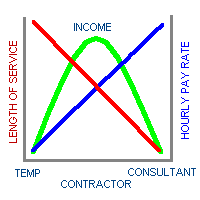
- Temporary Worker: A person hired to fill a chair and perform a job requiring skills rather common to the industry. For example, a computer operator.
- Contractor: A person hired to work on a project until complete. For example, a Cobol programmer who follows the program design of a systems analyst.
- Consultant: A person of specialized and rare expertise, hired to solve a difficult problem. For example, a mechanical engineer specializing in vibration theory hired to solve a problem with a machine tool design.
Notice that the temp can be retained almost indefinitely. Companies use temps to replace full time workers, but without paying benefits. The blue curve shows that the temp’s pay is rather low.
The contractor works for an extended period of time, from months to a couple years. The contractor’s pay is above the level of the temp.
The consultant works for a short period of time and makes a much higher dollar-per-hour figure than the other two.
The green curve represents the total amount of money earned by each of the three types. It is computed by multiplying the red and blue curves together. Note that it is not the high paid consultant who makes the most money in the long run, but the contractor.
Many ‘consultants’ I know are only interested in one thing: jacking up their hourly rate as high as possible. This ensures one thing: their period of service with each client will be correspondingly short. And their stress level is higher because they are always beating the bushes for more work, that is, finding another victim. They earn twice the hourly rate of a contractor, but spend as much time selling themselves as they do working.
On the other hand, a lower hourly rate allows companies to look at contractors in a similar way to employees: long term. Thus, you are trading job security for the promise of sporadically successful high rates. No one would consciously choose a feast-or-famine job, but some consultants do just that in how they structure their rates. The moral is: don’t be greedy.
Competition
Well, since I lost half the audience with that last statement, the reading should be easier for the rest of you. Some fields are very competitive, but consulting (switching back to generic terminology) is not usually one of them. People are selected mainly on the basis of prior relationships through word of mouth advertising. That is, it is not likely that an unknown consultant will walk in the door and steal your job if you have been doing good work — simply because you are a known entity and the new person is not.
For these reasons, consultants are not usually paranoid about competition, though prudence is prudent. In fact, the skill sets of different individuals generally vary so much that you can sometimes recommend a colleague for work in the same company without being in danger of eliminating yourself.
Corporations
One of the most important business questions is, should I incorporate? There are many pros and cons, and for the full details you should see a CPA and an attorney. Several issues are involved:
- Sheltering money in the corporation against taxes
- Protecting personal assets from legal attack
- Other tax consequences
- Paying for benefits with pre-tax income
These are all important, but the last is one that not many people think of until they start doing their own payroll deduction, seeing how big a bite the government takes out of each check. Thinking in terms of pre-tax dollars means understanding that if you pay a dollar for a personal item at the grocery, you had to earn about $1.50 for the privilege of spending that $1.00. Fifty cents of your earnings disappear into the black hole of government.
The crucial element is the fact that it is legal for your corporation to pay for certain things like health care and insurance without the money being taxed. It is an expense of the corporation. That means if you earn a dollar and buy health insurance (a rip-off in its own right!), you send no part of that dollar to the government. You should grill your CPA to discover all areas which benefit you thus.
Completing Work On Time
Once you get to work, you will likely have nightmares about delivering work late. Say, your alarm clock goes on the fritz and you oversleep — by two weeks! What do you do?
First, you are being paid to deliver the work on time. It is your responsibility to adjust your life to make that possible, while still doing quality work. You cannot do quality work on 3 hours sleep per night. This is not college! Someone is depending on you to get it right.
However, bad things happen. Somebody dies. Somebody is born. Your manager is a jerk. People lie to you about the requirements. The customer talks the company president into several more features. Some of these things can legitimately stretch the schedule, some not.
In my experience, when I have been late, I have found that it is always good to warn the customer well ahead of time. Weeks ahead of time if possible. That way he can compensate if needed. But if you are late, remember that it is better to deliver a job late and working, rather than nonworking and on time. A couple days of client fingernail biting will heal shortly, but having you deliver junk and then move in with your development tools to fix the mess will create a gaping wound which will be remembered long after you have been fired.
Accurate Estimates
The importance of an accurate estimate cannot be understated. Many programmers cannot estimate how long it will take to write and debug a well-defined program, to their disgrace.
The estimate has a number of obvious purposes, but there is one that you may not have thought of: protecting your reputation. If you consistently make poor estimates of completion dates or labor hours, you will tarnish your reputation quickly. This opens the door for someone else to take your job.
However, if your client cannot remember the last time you went over on an estimate or delivery date, you are invincible! There is no more powerful testimonial about a person than that he keeps his word.
Turning Down Undesirable Work
Every contractor has dry spells when there is no work to be had. At that time you should live off your savings (read that last statement several times before going on). The danger is that the telephone will ring and a less than savory character will offer you a small job, just what the doctor ordered, or is it?
Here are some examples of things I have heard:
- Wild Schemes. “We are going to develop this product (I know — it’s already patented) then when we are accosted for infringement we will just sell out to the patent owner and get rich!”
- Me-Too Products. Chances are, if you can name three manufacturers of a proposed product, there is not enough potential money waiting to support the client or you.
- Products With Small Markets. The killer here is that clients understand that the price per widget can be quite low if built in large quantity. But if the market is for 100 units per year, the price will never fall. You mission, therefore, is to make this possible in spite of the laws of physics, thermodynamics, and economics.
- Products Marketed To People Without Money. If you want to make money, you have to sell the product to people who have money to spend. That “personal microwave oven that’s just perfect for the homeless” is not going to be a big money maker.
- People/Communications Problems. If you find a person obnoxious, do you really want to work with him or her? Think about it.
- Jobs Dumped On Contractors. Some managers are tasked with completing projects that they have no interest in whatsoever. That’s the perfect time to call a contractor! If he fails, he gets the blame and so what? If he succeeds, all the better. Be careful that the projects which are to become important to you are important to your client.
- Working For Equity. “Gee, I don’t have much cash now, but would you work for stock in the company?” When you hear this — RUN! That means that a) the person does not have any money, b) the person never had any money, and c) the person likely will never have any money! You are not a banker or an investor. There are much better, safer, well regulated places to invest your cash.
- Working For Royalties. This one is akin to working for equity. If you can hammer out a contract which guarantees immediate minimum payments against the possibility of flagging sales, consider it. Otherwise, you are likely in for a long ride to nowhere.
- Fixing Other Consultant’s Botched Jobs. If another consultant has screwed up a job for a prospective client, be careful. The client is now behind schedule and overbudget, and not in a good frame of mind. Your margin of error is negative, meaning you have to make up for someone else’s mistakes before you even get to the positive side of the ledger. I avoid these jobs like the plague.
Choosing Good Clients
So then, how does one choose a good client? Several things are important: good reputation, a good credit history, stable financials, a track record of success, quality level comparable to your own, a company who will work as a partner with you, and a company that meets its own schedules.
Finding these is difficult because mismanagement is so widespread, management being substituted for leadership in so many companies. You simply have to listen carefully with each new lead to determine if you would like to work for them.
Working With Client Employees
When working with your clients, you may be called upon to work for extended periods with your client’s employees. This can be a difficult situation since there may be some apprehension or threat felt by them from the presence of an ‘outsider.’ This is normal. I have found it best not to deal directly with an employee who is acting less than favorably toward me, but rather to treat him and everyone else with fairness and courtesy.
Business Location
So where do you locate your business? The first three rules of real estate are location, location, location. But with telecommuting, that is not always true for technology consultants. Many work at home to save costs. The saved overhead can be pocketed if your rates are comparable to those of the large outsourcing firms, or you can lower you rates to undercut the competition, that is, the droid suppliers.
I have known consultants whose first act after incorporation was to rent office space. Bad move. Keep the overhead low while you build a client base, then look at the ritzy accommodations.
Building Your Reference Library
One of the largest projects I undertook when I started consulting was not a paying job: building a reference library. It is essential that you have at your disposal all the information you need to complete a job quickly, without having to wait on the postal service to deliver your mail.
Yesteryear, that meant ordering the latest data books when they came out. Most of the time they are free for the begging, but some are not. Product literature from major manufacturers in your specialty should be requested and kept on file in an organized format for quick location.
Today, however, the Internet places at my fingertips much of what I have already on the shelf in printed form. I look forward to the day when I can start burning all those old data books which I keep for the sake of paranoia. Who knows when one might need an 8080A data sheet? Data manuals are now becoming available for free on CD-ROM. I have moved all my data books several times in my life, but never again!
Your Skills
Of course, you are of no use to anyone without skills. These skills are developed in a number of places and we discuss those here.
The first place you develop your skill base is in college. The further I get from college the more I realize how little I was taught. You just cannot learn the tricks of the trade in school, no matter how hard you study. Wisdom comes from experience, and that takes time. That is why you don’t find too many 20 year old consultants, though you find some smart 20 year-olds.
The most valuable asset you have as a consultant is your skill and experience base. It is your list of design successes and failures. The failures are included because that is where you learn the most. You must seek the most difficult jobs throughout your career in order to make yourself exceptionally valuable in the marketplace. And you must understand how your skills fit with those of others to solve large, complex problems. After all, your clients are not paying you to coast, which is the attitude of some starving consultants.
Along that line, you will sometimes find yourself working capably beyond your schooling, and receiving some grief from those more highly educated than yourself. It is not an insult that they pay you, though that is what they intend, it is the highest compliment — thank them for it!
Personality
What kind of personality do your clients want in a consultant? How you interact with them determines your chances for follow on work. I have known difficult, sour consultants who did one job for my employer and were never asked to return. Let me give you some suggestions:
- A Get-The-Job-Done-Right Attitude. Sloppy work is a career killer. If your attitude is non-compromising regarding doing things right, that will infect the rest of the team and earn you respect.
- 100% Completion Rate, No Quitters Allowed. Don’t stop until the job is done and the product is solid. The only part of the race your client will remember is the part where you either cross the finish line, or cramp and fall in the final stretch. Even if you finish, you may lose. If you don’t finish, you certainly lose.
- Doing Quality Work. ISO-9000 aside, the Golden Rule works in consulting as it does in Kindergarten. If you would not buy what you are designing, why should your client?
- Honesty, Fairness. An honest person does not like to work with a dishonest consultant. The curious thing is that neither does a dishonest person!
- Willingness To Take The Blame For Your Mistakes. Nothing disarms your detractors like standing up and taking the blame for your mistakes, and then fixing the problem.
- Becoming A Partner, Not Just A Droid-For-Hire. If you focus on billable hours, you will be a slave to the clock. If you focus on building profitable relationships, you can smash the clock. I did!
2015 Update: Communications
One last bit of advice. When you are communicating in writing with coworkers, customers, or vendors, always use proper grammar and punctuation. Frequently I receive emails from others in business which appear to have been written by their elementary-age children. Frequently these have no punctuation, poor grammar, use Internet abbreviations, or lack meaning and context. Let me emphasize: ALWAYS USE PROPER GRAMMAR AND PUNCTUATION. And avoid the use of all-caps as it is distracting (!).
Let me assure you, poorly formed communications make you look like an idiot, and the world has enough of those already!
Conclusion
Go ahead, take the plunge! It is a big world, and someone needs your expertise. Consider the points above, talk to a lawyer and an accountant, get all the details right, and then go for it.
This paper is not intended to offer legal or accounting advice. For such advice, consult licensed professionals.
Author Biography
Hank Wallace is the owner of Atlantic Quality Design, Inc., a consulting firm located in Fincastle, Virginia. He has experience in many areas of embedded software and hardware development, and system design. See www.aqdi.com for more information.