
We’ve had raving customer reviews of our new ZEROCAP cable capacitance eliminator. Many prospective customers have written to ask how it compares to major cable brands, so we bought five popular (and sometimes expensive) guitar cables and tested them side by side with the ZEROCAP.
Here are the results:
(lower=better) |
(lower=better) |
||||||||||
*This data was taken using our first generation ZEROCAP cable. The product has been improved with increased shielding and battery powered operation. Please refer to our ZEROCAP page for current pricing and specs. Fortunately, our ZEROCAP cables all sound the same, so the clips are representative of the new models!
The clean clips were recorded using a Shure SM57 microphone in front of an early 1960’s Fender Deluxe Reverb amplifier, tone controls set to ‘5’, with a JBL K-120 speaker. A PC was used for recording. The guitar was a Fender American Strat with all volume and tone controls on 10. The bridge and middle pickups were selected. The sound clips have been normalized but not otherwise changed.
The dirty clips were recorded through a DigiTech GP7 into a PC sound card using the same guitar as above, the bridge and middle pickups selected. The sound clips have been normalized but not otherwise changed.
Old technology cables kill high frequencies. The higher the capacitance, the more muffled the sound. This is readily apparent on the Cable5 cable clips (it having the highest capacitance) and is an example of how all old tech cables behave.
Old technology cables create a midrange honk. The cables with the highest capacitance produce the greatest midrange peak. We all know that midrange is what makes a guitar cut through the mix, but having your cable control the midrange balance is ridiculous! That’s why your amplifier has tone controls and the cable doesn’t. The ZEROCAP clip demonstrates flat, even response that leaves you in control of the sound, not some wiring engineer in another country.
What does all this mean? The critical parameter above is the cable capacitance. You can read an article here that tells you in detail what it does to the sound, but briefly your ears will hear more high end and less midrange boost with low capacitance cables.
The Cable3 cable is the lowest capacitance of all the standard, old technology cables, and at 352 pF, it’s not bad. But the ZEROCAP has over 13 times less capacitance than the Cable3 cable!
On the other end, the Cable5 cable has 52 times the capacitance of our ZEROCAP.
And per foot, the ZEROCAP cable is by far the best, 21 times better than the Cable3 cable, and a stunning 79 times better than Cable5! The tiny residual capacitance of the ZEROCAP cable is basically the capacitance of the connectors.
What about the other parameters? The inductance of a cable affects the high frequency performance, but only for canine guitarists. That means the negative effect only becomes important at ultrasonic frequencies. Unless you play a guitar with 200 frets, the inductance is not a factor in how the cable sounds.
The cable resistance should be compared to the impedance of a guitar pickup, a few thousand ohms. The resistances measured in all the cables tested are so small they will have zero effect on the sound of the instrument. (Resistance is very important in speaker cables, however!)
Of course you have to consider other factors such as the physical configuration of the cable. The old tech cables tested were constructed decently, but were all quite stiff. They were all resistant to coiling, or resistant to laying straight. The ZEROCAP cable is soft and flexible, and of smaller diameter than the others. If you need a stiff cable, the standard ones will do the job. But if you want a cable that does NOT have a mind of its own, buy a ZEROCAP.
What if I like a muffled, nasal tone? That’s your choice. Go for it! But don’t let your guitar cable dictate your tone. Use a ZEROCAP and then select your amp, pedals and speakers to get whatever tone you want.
Hype Detection
We also analyzed the packaging and literature that came with each old technology cable for hype and snake oil, and we found some for sure. Forgive us if we don’t participate. The ZEROCAP cable is made from quality raw cable, with quality connectors and quality assembly, hype not included. The final determinant is of course how the cable sounds, and the biggest contributing factor is the cable capacitance.
Order a ZEROCAP cable today and hear for yourself how it compares to the cable you are using now.
Where are the Brand Names?
We had brand names attached to the data above, but we received a call from one of the manufacturers, disturbed to say the least (because his cable had X times more capacitance than ours). His point was that cable capacitance is not the be all and end all of cable selection, and he’s right. Construction and flexibility are also important. But capacitance is the important tone factor in cable construction.
To minimize industry angst, we have removed the brand names from the table above. However, it does not really matter because the ZEROCAP cable is better per foot by at least 21 times and as much as 79 times compared to the old tech cables. The ZEROCAP is in a totally different class. If we were quibbling about only a few percent here or there, perhaps the brand comparison would be important.
Capacitance is the Important Tone Factor
How can we say that? We did a test where we added capacitance to the cables above until they were all the same (about 1440 picofarads). We then tested the frequency response using a 5.6K ohm pickup resistance and a Hewlett-Packard audio generator/meter. The graphs appear below. You cannot see that there were five cables tested because, within a fraction of a dB, all the cables had utterly identical frequency responses.
In the plot below, you will see no “rich mids,” “gutsy lows,” or “smooth highs.” There is nothing that distinguishes one cable from another, some of them even being patented. It is interesting that the only sound difference each cable can claim relates directly to the capacitance and nothing else.
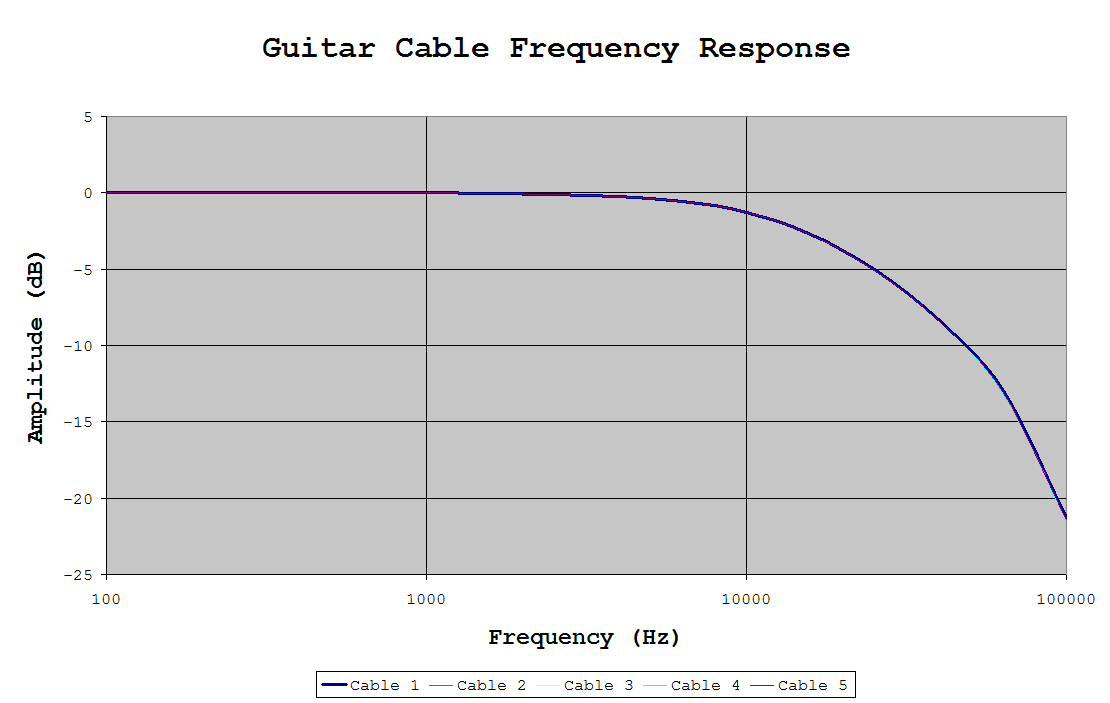
This test shows that all the other factors, such as stranded vs. solid conductors, solid vs. foam dielectrics, copper chemistry, conductor cross section, cable shape, etc., have essentially zero effect on the sound of a cable, except how those factors affect capacitance. THE number one factor by a large measure is the total cable capacitance. The other factors may change the size, durability and feel of the cable (perhaps to some benefit), but not the sound.
Please note that the ZEROCAP cable had exactly the same response as above, when we added capacitance for a total of 1440 picofarads.
Actually, the fact that the responses are identical is comforting. Any cable that had a different response (say, in the midrange) would be defective!
The ZEROCAP Simulator
You can actually simulate the effect of a ZEROCAP cable. Take one of your short (6 inch) pedalboard hookup cables and use that as a guitar cable. The cable is so short that the capacitance will be very low, less than 75pF. If you can, use that tiny cable between your guitar and amplifier for a few minutes and you will almost hear the definition a ZEROCAP is capable of, except the ZEROCAP is not quite so short and has even less capacitance!
Compare that tiny cable to your existing cable and you will hear a big difference. Then order a ZEROCAP so you don’t have to spend every gig with your hip glued to your amplifier!