
(C) 2003 Hank Wallace

Technician Vipperman considers becoming an engineer.
It was 1983. I was working with another contractor on a job for a large company. We were designing a wafer probing system to characterize the output of a new gallium arsenide wafer fab. Working there with the regular employees, I became friends with many and enjoyed the several months I had with them, but I was considering what to do after that job expired.
Then I saw an ad in the newspaper for a test engineer in a different division of the same company, but actually right across the hall from the clean room where I worked. I applied and was granted an interview.
The day of the interview, I was working on the wafer probing system as usual, so I just took off my bunny suit, walked across the hall and introduced myself. It turned out that the job they had in mind for me was not test engineer (as advertised), but a technician job calibrating scopes and meters. I inquired about the discrepancy and the interviewer politely told me that I could not be considered for an engineering position because I had no four-year engineering degree. So I thanked him for his time, walked back across the hall, put on my bunny suit and continued my engineering work at an engineer’s pay.
Are you an electronic technician who would like to become an electrical engineer, willing to do the work and study to achieve that goal? Good! Many do it every year, and in many ways. I did it right inside a company that refused to hire non-degreed engineers. Knowing my work but not my education, one MSEE there even asked where I did my graduate studies.
This article series is for techs who desire the title and responsibilities of engineer, and are willing to put in the hard work to obtain it. I will describe the engineering job, what’s required to get there, and what’s required to stay there.
You have a great future ahead. I have heard often that the best engineers are the ones who were first technicians. They get the job done, regardless the problem. They know which end of a soldering iron is hot, how to use a scope, and they have great detective abilities. With the addition of an engineer’s general background they are unstoppable for one reason: they are successful.
From the outset I am assuming that you want to be an engineer for the right reason — you love electronics. If you want to be an engineer just to take home a bigger paycheck, you should be working on your real estate or insurance license, or working for a non-profit company (a dot-com). Those afflicted with and addicted to electronics, read on.
Good Engineers Practice Fire Prevention
Just to establish my position before the flame emails start pouring in, I think that the best route to the title ‘engineer’ is the BSEE degree. However, not all will choose that path, and there are other paths. As a preemptive measure, I will now state the objections of the large group of engineers who wince at the thought of anyone gaining the title ‘engineer’ without obtaining a BSEE degree from Big Name U. In the following paragraph, select one or all of the options in [square brackets] as the mood moves you.
“It [burns my biscuits] [toasts my transistors] [makes me really mad] that some [low life] [ignorant] [gen-x] [low IQ] [calculator toting] technician could be called engineer without having the proper education. I worked [hard] [really hard] [super mega hard] in engineering school [sleeping only 4 hours a night] [holding down two jobs] [flipping burgers] [being a co-op student]. The experience of the technician counts for [little] [nothing] [less than nothing]. If he does not earn the title [the way I did it] [the canonical way] [by paying his dues], the he does not deserve the title.”
Don’t we all feel better now? If you are just itching to launch a flame war, please refrain as we have read all that before in the IEEE editorial columns. Your core exhortations to techs to earn a BSEE are noted, applauded, and admirable.
On the other hand, if you are a technician looking for an easy title upgrade, you do not have my encouragement, either. There is no substitute for knowledge, experience and wisdom, not even a degree. Certainly not a title. You might even get the title before you are ready. There are lots of MBA engineering managers who have never designed a working product, and they are ready to promote anyone to engineer who can make them look good. If this happens to you, start working fast on your knowledge base because you are in a very dangerous position.
Since I have just dissed half my readers, who then has my encouragement? The tech who has the right attitude and is ready for loads of study and hard work. With that and some experience you can get the title, the fame and the fortune. Well, maybe just the title.
In the next section, we will define the terms engineer and technician, and after that we will look at what an engineer needs to know and do, and how to get from here to there. Your training and experience as a technician is an excellent starting point. That plus a well thought out plan of action has launched many a successful engineering career. But remember, there are no short cuts!
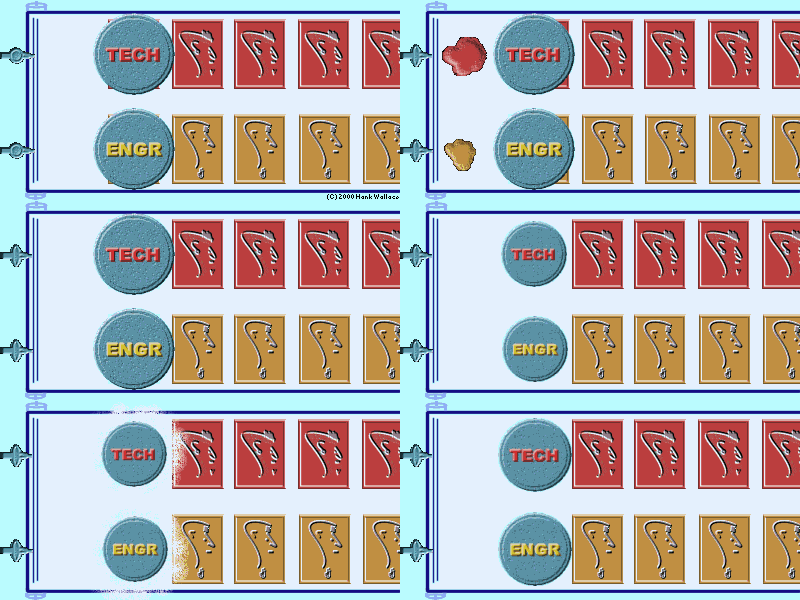
The process of making technicians and engineers is similar, but the course material is quite different.
To continue, and just so we all use the same terms, I present a couple definitions.
What Is A Technician?
Let’s start with what you as a tech already know. A technician typically has a two-year Associates degree from a junior college, or a technical degree or certificate from a military, trade or specialized training school. The quality of education varies widely among technicians, depending on where they train. The military trains many technicians and the ones I have worked with know their stuff pretty well. I think it has to do more with boot camp than tech school. The military used to teach electron flow instead of conventional current flow, and that was one point of confusion for some techs. (Does the military still teach that?) As with engineers, the functional, on-the-job quality of the technician is only loosely related to the quality of his (or ‘her’ in all that follows) formal education.
Job duties for a tech include maintenance, repair, field work, and for engineering technicians, building prototypes of new designs and products. A good tech can take a sketch and build it and debug it without much help from the engineer. That is why a good technician is worth his weight in gold. He allows the design engineer greater freedom from the bench while performing challenging work in his own right.
What Is An Engineer?
An electrical engineer on the other hand is typically educated in a college or university, obtaining a Bachelor’s degree in Electrical Engineering, Electrical Engineering Technology (more on that later), or a related area. There is not as much variation in the format of educational programs for engineers as for technicians, but sadly there is just as much variation in quality of the result. More sadly, most victim engineers do not realize until years later they received a substandard education. There is a huge difference between an A grade engineer and a C grade engineer, though both of their business cards read the same.
Of late there is a trend toward the Computer Engineering degree. This is a curriculum that is lighter on the analog side, fields and waves, radio theory, and possibly some basic sciences. That hole is filled with more study in computer hardware and software. I will consider the BSEE and Computer Engineering degrees equivalent for the sake of our discussion, though you will prefer one or the other path. As an aside, watch out for those who argue that digital is better than analog, or communications better than power, etc. Find your area of interest and excel in it.
The main difference between the engineering and technician curriculums is the theoretical development of the material. For example, technicians need not know exactly why the semiconductors are doped a certain way. They only need know how they function in a circuit. However, engineers must be aware of the theoretical design details of each electronic component to fulfill their design duties to the fullest.
Though engineers have some coursework in the pure sciences, (chemistry, physics, biology) and considerable coursework in math, the engineering curriculum is considered ‘applied’ by the scientific community. Thus, you will find that scientists and mathematicians look down upon engineers as lacking theoretical background just as engineers look down on technicians in that way. I suppose politicians consider the scientists who work for them inferior as well. Isn’t there always a bigger fish in the pond?
What Background Does An Engineer Need?
Assuming you are a technician, what additional background do you need? You may be surprised, but engineering and technician educations are different from the ground up. You will have to go back to the basics and effectively start over. It is a matter of depth of study in each area. But take courage! Your background gives you an excellent advantage because in most areas you will be adding to what you already know, though in some areas you will be breaking new ground. To the green engineering student, everything electronic is new, but you have a framework of understanding to build upon. You also already know how to study. Having a technician background myself, I found that I could burn through engineering courses with much less pain and agony than the other students.
Though we will not dwell too much on specific EE course material here, you can find an outline of a typical curriculum from Virginia Tech, a mid-tier engineering school at their web site. Shooting for the top of the class? Then check out Stanford’s requirements. Compare those programs with the popular electronics technician program from DeVry. (You’ll have to dig for the requirements because the PhD’s keep moving the relevant pages!) Many universities offer EE courses online and post their requirements and assignments on the web. You might find the web site of an engineering school near you and check out the course work to get an idea of what you are up against.
Reading the requirements for an EE degree, you will certainly see some courses you could ace right now. Much of the liberal arts course work may be satisfied by your prior schooling. You need to ask a college counselor to be sure. Courses transferred from an accredited junior college are usually worth more in transfer credit than those taken in a technical school. When determining what will transfer and what won’t, deal only with an admissions counselor who has the authority to sign the transfer forms. The opinion of your cousin Ernie who when to school with Edison doesn’t count.
If you peruse several degree plans from different engineering schools, you will notice some differences. Why is this? One would think that some accreditation body would have boiled the BSEE requirements down to a common set of courses at all schools. The answer is that schools focus on one area more than another. Some dwell on power engineering, others on communications or fiber optics. The school’s strength affects its curriculum, though the basics of engineering are the same just about everywhere. People who have a particular area of interest find the best researchers in that field and attend the school where that work is being done.
Keep in mind that the initial education is only the first step in becoming an engineer. Though you get the title when you get the degree, understand that an engineer in title only is a dangerous thing. I could tell you horrific and humorous stories about new-grad engineers who were too big for their britches. The degree gets you just enough book learning to qualify you to burn up real components on a company payroll, and that’s frightening.

Characteristics and actions of a good engineer.
What Skills Does An Engineer Need?
We have been discussing the transformation from technician to engineer. An engineer is a generalist. As such he must be capable of wearing many hats. Here is a short list of skills you must have as an engineer.
-
Designing working products and systems.
- You have been hired to design electronic widgets. Needless to say, the widgets have to function, right? That’s your most important job function, doing what the marketing suits cannot do: designing a working product. Their work product is evaluated at the end of the quarter and forgotten. Your work product must function down to the last nanosecond for the next thirty years.
-
Designing robust products and systems.
- Seeing one unit work in the lab is nice, but you get no cigar. That’s because each design must be robust. That is, it must work when replicated a million times using 5% and 10% tolerance components. It must work over extremes of temperature. It must work after it is dropped off the back of a truck. Get the idea? Building one is easy. Building a million is tough.
-
Working with other engineers.
- You are not working alone. Even if you are working in your own business, you must work with engineers in other companies. You must supply the team with skills corresponding to your strengths. You must lead and mentor other engineers who are not as experienced while encouraging their growth. No snobs allowed. You must serve other engineers from whom you can learn. You must get the job done together.
-
Working with management.
- Why are you employed as an engineer, anyway? “Because it’s fun.” If I handed you a check for $10^6, would you still work? Maybe, but probably not. You work for the money. Your company exists to make money. That’s it. You have to work well with management, and the best way to start is by understanding their motivation: making money. If you keep that goal in mind, you will have far fewer problems.
-
Leading technicians.
- Being a technician, you perhaps understand what it is like to work for a goofball engineer. As an engineer, do not be a goofball! Treat your techs right. Don’t give them a circuit to build which you have not thought through. When a tech finds a mistake in your design, thank him. Treat your tech as you would like to be treated and he will make you look good on a consistent basis.
My first job as a tech was with a huge company. I was hired in June along with a large crop of new-grad engineers. One of them referred to the techs as “grunge technicians.” What a downer that was. As an engineer (or in any job), belittling others, especially others upon whom you depend, is the short path to the bottom of the food chain. Don’t do it.
-
Being a generalist.
- As an engineer, you are trained with general purpose math, chemistry, physics, and mechanical analysis skills. When you encounter a problem which cannot be solved by the tools in your toolbox, what do you do? Learn another tool! “Thinking outside the box” is a hackneyed phrase of late. As an engineer, you must guard against ever getting anywhere near the “box.”
When I was a tech, I thought in specifics: measurements, data, procedures, troubleshooting. It’s hard to explain what general thinking is, but I’ll try. General thinking is the ability to use wide areas of knowledge and experience, drawing analogies to aid your understanding, and filling in the gaps with study without regard to disciplinary boundaries. For example, you ask me to design a radio controlled toenail clipper. I already know how a manual clipper works, and that’s the base where I start. I also understand something about radio. What’s needed here, in my case, is an understanding of the forces required to actuate the clipper, the statistical range of toenail sizes, the physical properties of toenail material (isn’t that called chitin? — my first research topic), safety issues (UL, CSA, VDE toenail clipper regs), regulatory issues (FDA, FCC), and marketing requirements. Know any good toenail models?
See? You start with what you know, and being aware of areas of basic science as a result of your education, you know what questions to ask to get to the next step in the process. A technician uses what he knows and has been taught on the job and in school. An engineer extends that knowledge in real time to get the job done. That is a general thinker.
-
Filling a blank sheet of paper with a working design.
- You have to start somewhere. You start where you have been. As an engineer you are expected to solve problems from scratch, starting with only your experience. Sometimes you can learn from another engineer’s design, but many times you are on your own. Nothing can be more rewarding than creating a working product out of thin air, but nothing can be more terrifying, too.
-
Learning what you need to know to get the job done.
- Are you working with a biologist this month on a new assay machine? You are going to need to know something about what you are measuring in order to design the electronics correctly. What is the range of measurements, say, in orders of magnitude? How long does the test take? Can it be done in less time? How does temperature affect the readings? You need to be able to quickly learn a basic level of functional knowledge about the project at hand, not being an instant expert, but knowing enough to ask intelligent questions.
-
Debugging designs.
- Once your kind tech has built your design, you may have to debug the most difficult problems. Do not leave this task to someone else. Gain the valuable experience. A pathetic sight is an engineer who cannot debug his own designs.
-
Get your hands dirty.
- This includes knowing how to solder, lay out a circuit board, draw a schematic on something other than a napkin, competently perform tests on production units (and record the data correctly), use wire cutters with only one hand, and other practical tasks that many primadonna engineers eschew. Ever see an engineer counting on his fingers to determine a resistor value from its color code? A surgeon does not leave that menial cutting task to the nurse, but must know how to use a scalpel. But if you’re a technician, you already have these skills.
-
Learning from failure
- As a technician in a lab, you know that the engineer has the ultimate responsibility for getting the widget to work. Therefore you can spend your Friday evenings at home like civilized folk. But the engineer’s neck is on the line, so he stays late. That sounds like a good deal for the technician, but actually the engineer benefits more because he learns from the failures first hand, giving him a depth of wisdom technicians sometimes lack (though not always). Engineers take more risks than techs and their failures are more profound, but so is their learning.
-
Excellence
- Another basic engineering requirement is that of doing A-grade work at all times. When I was an engineering manager, if someone came to me with C-grade work, I kindly gave it back to them. If the next iteration was B-grade, I gave it back again. I have never met an engineer (or technician) who was incapable of doing A-grade work. You can get out of engineering school with a C average, but you cannot hold a job working that way. Aim for mediocrity and you’ll get there. Aim for excellence and you’ll get there.
Notice that most of these skills require a measure of what you already know as a technician. As an engineer, waiting for a technician to come back from vacation to wire up a prototype will kill your schedule. Getting the job done right means having a superset of the technician’s skills, not a different set of skills. That’s where many engineers fall short, and where others excel to the level of superhuman reputation.
I did not include in the list the basic requirements of any job. For example, you have to show up on time, be diligent at your work, and have a smile for the boss and your coworkers. As a working tech you already have developed these skills.
How To Make The Transition
The first thing you need to do to become an engineer is to get a degree in electrical engineering. I had to say that to satisfy many readers because there are those who say “You’re not an engineer unless your degree says so.” Unfortunately, in the real world everyone from trash collectors to train drivers are called engineers, but the devaluation of the title is another discussion.
Notice that I said the ‘first thing’. The implied second thing is experience, which will be covered later. I just don’t want you to think that the sheep skin magically confers some special wisdom. (Personally, I think that new-grad engineers should be called something else for a few years until they get some experience, but in deference to my email in-box I will not belabor the point. Plumbers do it, why shouldn’t we?)
In reality, there are many flavors of electrical engineer, many with respect to both education and experience. With only little experience, your education will determine the best job you can get in industry. Don’t believe that you will be running IBM’s R&D wing without a politically correct degree. On the other hand, with a Bachelor’s degree in just about anything technical and the electronics know-how of a technician, plus engineering-level thinkability, you can land a respected engineering position, just not in a nuclear power plant. There are many shades of engineering work.
Why settle for less than a pure EE degree? Two reasons. First, employers are mainly looking for solutions to real problems. (You won’t lend much prestige to the staff with only a BS, whatever your specialty, so count that factor out.) As a technician, you already know how to solve difficult problems in electronics. You need to add to that the theoretical base that enables you to think in general terms and be more creative. If you have that, you can be anything you want (within the law).
The second reason to earn a non-EE degree is that the most convenient technical degree may not be EE. It may be math or computer science or physics, depending on local course offerings, what will transfer from your past education, and how wealthy you are.
Companies also look to broaden their base of expertise. So, if you have a degree in physics with loads of electronic experience, that is attractive in several fields of applied science. There is nothing worse than an EE who doesn’t know basic science, and there is nothing better than an EE who knows where electronics fits in the big picture, with the ability to converse in other disciplines.
What about the BSET (BS in Engineering Technology)? Several universities offer this degree, directly transferring Associate’s Degree work from junior colleges. The BSET curriculum is typically not as mathematically rigorous as the straight EE program. However, many companies find ET grads to be excellent employees in areas such as test and manufacturing where a lot of high powered design skill is not needed. Just be ready to be the target of some nasty jokes from the ‘real’ EEs. I have known some BSET grads who were the equal of any EE. The real measure of the engineer is again the person and not the paper.
Why are BSETs disrespected in some companies? Because many pay BSETs just as much as money as BSEEs, which galls the EEs. In fact, I know of one four-year EE program that pressured its sister BSET program out of existence because the ET grads were getting lots of job offers. That darn food chain.
What About Professional Licensure? Go for it! If you can earn a PE license, it can only be to your benefit. You are going to need a lot of experience, study and qualified industry references, though. The Engineer In Training (EIT) certificate is also a plus in your efforts. These steps indicate extreme commitment on your part to the engineering career path. There are several study guides and web sites dedicated to PE licensure. Do some research and see whether this step makes sense for you.
If you enroll in engineering school, you are going to need some help, believe me.
Surviving Engineering School
Let’s say you have enrolled part or full time in a local engineering school. How do you survive for the next few years? I’ll provide some pointers.
-
Weeding Out The Sissies
- Most engineering schools receive many more applicants than they can handle. I suspect that they also accept many more students than they could possibly educate in four years. That means that they need to ensure that the least capable students don’t make it to the upper levels of college education. Consider it education filtration. Sad but true.
Doing the dirty deed is a batch of courses designed to put students through the ringer. These are not just engineering courses but are sprinkled liberally throughout each curriculum, usually in the first year. Calculus is the most well known. Either the student learns to study and survive, or he drops out. Unfortunately there are often not enough staff or teaching assistants to help all the failing students, and the attrition rate is high.
We accept this as a fact of life, but I dispute the necessity of this system. I always did well in college, but I had many friends who struggled and received in response only a stern rebuke from a professor when what they really needed was encouragement. The moral of this warning is, be sure your have a support network in place. These support people could be working engineers, professors you know personally, or other resources like family or the Internet.
-
Secrets To Making A’s In Technical Courses
- When I tell college freshmen that there is a secret to making A’s in the hardest technical courses, their ears perk up and they lean in for more. Then I let them in on the secret: Work every problem you can get your hands on, every one in the book, and then go to the library and find some more and work them. It takes time, but it really pays off. You should see the disappointment on their faces!
But I am not kidding. You were not born knowing physics or dynamics of rigid bodies, and neither was I. To ace these problem oriented courses you need practice. I used to go to class and work problems during the lectures. Then I came home and did three or four hours more. I worked until I had at least attempted each problem in the text.
The problems that gave me difficulty I brought to the professor. Talk about surprised! When a professor sees that a student’s notebook contains 50 pages of problems and solutions for each chapter of the text, that is a big bonus at grading time, but you are probably not going to need that extra point between the B and A because you already aced the course. (One physics professor came to me and asked about a problem in the text!) Anyway, many professors take problems right out of the text because they know the students don’t do anything except what is assigned. I could hide the formula for making gold out of chewing gum in the advanced section of a calculus text and be in no danger of discovery.
-
Secrets To Making A’s In Nontechnical Courses
- So how do you make A’s in those nasty nontechnical courses? Since there are no problems involved, it is hard to practice your way to an A. The liberal arts professors are an odd lot, and they don’t think like we techies do. They read the same old essay tripe from students year in and year out. If you want to get an A in one of those mush courses, you have to get their attention with some original thought.
“Original thought? Are you kidding? I thought the objective was to blend into the woodwork and sneak out with a B or C.” That is the objective of the average student, but you are aiming above mediocrity (50% of the population is below average), so you need a better strategy. That strategy is the frontal attack.
You see, most of these liberal arts professors could no more do a math problem than change their oil. But they are not stupid, and they can recognize creativity and originality. Take advantage of this by writing papers that challenge the status quo. Buck the system. But be careful exactly how you do it. You cannot conclude that Shakespeare was a loser, but you can conclude that one of his characters is a remarkable archetype of a modern societal role, say, the uniformed businessman loser. They can disagree with your opinion, but there are no facts to dispute. Let your passion carry the point. Certainly you are passionate about something. Hello? You still there? Don’t let me down here.
With liberal arts courses, there may not be a ‘right’ answer, and searching for one or arguing absolutes will only turn out to be a waste of time and lower your marks. Your task is to entertain the professor. Just make sure you repeat the basic facts along the way to lend some substance.
This method can be quite fun, if you play it right, because you can occasionally trash the course material or text and get an A!
-
Working Ahead
- Engineering school is no leisurely activity. However, there are breaks between semesters. You should purchase early all the texts for your next batch of courses and start reading. What a horrible feeling it is to be six weeks behind after the first class day of the semester, having been assigned ten chapters reading among all your classes.
-
Getting Along With Professors And TA’s
- After ten or fifteen minutes at a large university you will realize that the full professors do little real teaching of the freshman and sophomore courses. They are there only as figureheads to lend credibility to the 22-year old teaching assistants (TA’s) who took the same course a few years prior from an earlier crop of TA’s.
It is frustrating not being able to talk to the professor, especially when the TA obviously is clueless. Being a person who has worked in industry, you will be very sensitive to this in college when a TA five or ten years your junior tells you that the CHOP setting on a dual trace scope helps to eliminate offset voltages on the inputs.
I once took a course in rudimentary assembly language programming. There was a simulator program that some grad student had written so we could ‘execute’ programs on this mythical machine. However, the program would only run on a PC (new at the time), and the source was locked to prevent students from changing the simulator. I asked the professor if I could get the source so I could run it on MBASIC on my CP/M-80 machine at home, to which he replied, “MBASIC?” It was obvious that he had no clue as to how the simulator worked or in what language it was written. Rather than argue with this goofball, I cracked the lock myself and did the work at home.
Another story. My brother was a PhD candidate at Humongous University years ago. He is an electronics guru and a professor in a junoir college, but was pursuing a doctorate in education. In a class on technology taught in the college of education, the professor announced that the computer term ‘open architechture’ referred to machines like the Apple II, where the case was easy to open to add new cards. My brother was smart enough to stifle the laugh!
You must be tactful. Remember that these people with virtually no industry experience hold your future in their non-calloused hands. They likely view you as a non-person, but just ignore that and be nice. Never let them know that you know how the real world works. And you will no doubt meet some savvy, affable professors who will more than make up for the dorks.
-
Cheating
- Whatever the honor code says, there is cheating in college. I remember that some dopers in one of my classes started making A’s on some really tough mechanics exams. These were normally the squeak-by-with-a-C students. I alerted the professor that something may be happening, suggesting that he not recycle tests from previous years. During the final exam, there was the persistent sound of dripping sweat as those guys worked some original problems that had not appeared before. Don’t be afraid to aggressively level the field.
Another sophomore level class was taught in a large lecture hall, but there were only about 50 students in attendance. The day of the first test, the hall was full. The test was rather easy. The next day, there were 50 students again. I figured the kids were sharing their notes. However, I learned years later from another student that the professor gave his tests in two or three year cycles. That is, he was practically an accessory to cheating. What can one do?
I assume that you would never stoop to such dishonor. Whenever you see or suspect cheating, however, you must take action because cheating devalues your degree.
A colleague years ago related to me how he got an A in a class by doing yard work for the professor in their well known engineering school. To this day, the mention of the school’s name evokes my suspicion.
-
Workload
- Part of the culling mechanism in engineering school is the spectre of workload. But you don’t have to take a full load, especially if you are working. Have no family of your own? Then burn that candle at both ends. But if you have a spouse and kids, be careful to balance your priorities. One sure way to get a B instead of an A is to run out of time or energy while rocking a whiny baby, or talking to a divorce attorney.
Shortening The Path To A Degree
Seeing as you already have some college credit from your tech schooling (even if only physed), you need to take the fastest, least expensive way to your goal: graduation. Note I am not implying that there are short cuts. But any fully accredited school has some options for compressing your education.
The first option is independent study courses. With these courses, you do the work and study on your own, reading texts and papers, and writing papers or doing other projects to demonstrate your command of the material. There is usually a lot of reading and writing involved, much more than in a traditional class. (I like to write and read so it was no big deal for me.) Such course offerings are exploding because the baby boomers are demanding that they be allowed to finish their degrees while working, paying a mortgage, and shuttling kids to soccer. The benefit to you is no wasted time sitting in traffic to and from class, and no wasted time in lecture while the professor proceeds at the speed of the slowest student.
Some professors are amenable to offering a course as an independent study even though the course is not usually done that way. I took a microcomputer interfacing course that dwelled on basic stuff I had known for years. I asked the professor if I could do a project instead of driving 40 miles one-way to class and he agreed, but on the condition that he could name the project. He chose a scrolling LED display, common today but not then. He seemed shocked when I delivered the working hardware to him at the end of the term. But I got my A and avoided about 2,000 miles on the road!
The second compression option is accelerated courses. I took a whole year of chemistry over one summer and it was wonderful. Every waking moment was filled with radicals, valences, and shells. In fact every sleeping moment was, too. Lecture was in the morning, lab in the afternoon, and in three short months I had fulfilled my chemistry requirement. The course format resulted in a lot less driving (bicycling actually) and zero opportunity to forget the material before the exam.
Some students look forward to taking the summer off. Don’t do it! Especially if you are a full time student, use summer offerings to trim some of the load from your regular schedule. As with component failures, it is the peaks that kill you, in this case schedule overloads. Use the summer term to lowpass filter your course load.
Another option is the CLEP, or College Level Examination Program. When you talk with your counsellor you will find that you need to earn your last one or two years of credits directly from that institution. The rest can possibly be taken at a local junior college or you can test-out using CLEP. See their web site for information on ordering the excellent printed study guide.
The CLEP exams cover a wide range of subjects, mostly the basics taught in freshman and sophomore classes. Credit is awarded by your college on a pass/fail basis, and you can take the tests multiple times. With the direction of your college counselor, select degree requirements that can be satisfied by passing CLEP exams. The exams are given monthly or quarterly in most colleges. What’s more, the exam will cost you only a fraction of what the college course costs (about $55 per three semester hours where I took them). You still have to study for the test, unless you have a natural interest or ability in the subject. You must learn as much as you would sitting in class anyway, so this too is not a short cut.
The last topic I want to cover here is distance learning. Colleges are realizing that busy adults want an education but the cost is just too high to quit work and go back to school. They are also realizing that there is are massive sums of money straining to be spent on education by these same people. The solution is distance learning. This allows mature people to take courses remotely, either through the mail, via email, over the web, or using videos or other technologies. Travel time and expense is reduced or eliminated, and other costs such as child care are avoided.
I earned a math degree from a fully accredited private liberal arts college in Virginia, Mary Baldwin College. They have been operating a large adult degree program for over twenty years. Once again, the program is fully accredited. Don’t waste your money on a non-accredited degree. There are ‘colleges’ on the web that will email you a degree in anything for $10, so you must be careful. (No one will respect a degree with banner ads, anyway.) The quality of a distance learning program is generally equal to the quality of the on-campus program. No on- campus program? No campus? You figure it out.
Most of the courses I have taken have been of the independent study format, though also offered are tutorials that consist of a dozen or so students. Some professors have required that I drive to campus every so often for a face to face discussion of the material. That kills some time, but on the other hand I get a private tutorial with an expert in the field, and I usually end up exploring some work related area that interests me such as error detecting and correcting codes. Of course, lab courses require the student to be on-site, unless you enjoy dissecting frogs on the kitchen table.
Distance learning (DL) is growing. I did a quick Internet search and got more hits than I could investigate in a week. The best place to start your inquiry is at the nearest college. Talk to a real person in counseling and they will give you some solid leads to investigate.
I suppose it would even be possible to paste together a mosaic degree from several colleges using distance learning. But beware that all respectable institutions have a requirement that you earn all credits for your last one to two years directly from them. I suppose that allows them quality control. And not all courses are alike. Check with your counselor before signing up for a DL course.
Oddly, DL is being accepted faster by students than by administrators. The old guard thinks of education as requiring bricks and mortar, chairs and chalk. Not many are willing to accept that a large proportion of students could do all their work from home and never set foot in a classroom (except for labs). In my city, several local colleges and universities, along with local government, have taken an old office building and rennovated it into classrooms and offices to the tune of $12 million. One of the programs moving into it is my own. This is ridiculous! With distance learning, we should be needing less real estate, not more. But that’s the taxpayer in me griping.
Gaining Experience
Some engineers never obtain an engineering degree, but work their way into an engineering position with a combination of personal study and on the job training. How do you do that?
Experience is not the only factor in such a transition, but the education comes not in a classroom. If you can demonstrate the characteristics of an engineer (see above), and you are personally mature, and you have studied and applied the techniques taught in engineering school, many a company will confer upon you the title of engineer.
However, there are some drawbacks. This transition usually takes many years, and rightly so. You will not be respected by all other, ‘real’ engineers, even BSETs. Also, technicians moving up to engineer are not paid as well in some cases. Say the employer has an engineering position open, one that does not require a lot of theoretical knowledge. The market says $60,000, but the budget says $45,000. You are being paid $35,000 as a tech. You get the job for $40,000, and take your family out for steak. Your boss takes his boss out for steak. Everybody’s happy, but you are making $20,000 less than a ‘real’ engineer.
If you do the math and consider the time value of money, something taught in engineering school, the income you lose as a technician working up to engineer is quite a lot. It pays to get the degree, if you can. But if you can’t, leverage your experience to gain the title. Stay in the job for several years to build up a base of engineering experience before you start shopping for another job.
Junior Engineer
Many companies have a junior engineer program. This is effectively a career track into engineering. Taking the company’s track is smart because it gains their blessing, which expands your job opportunities within the company.
Some companies also pay educational expenses toward a degree. Take advantage of this if you can, because paying for your own education puts a horrible load on any family, reducing your chances of graduation and happiness thereafter. The sheepskin is no fun if it comes with divorce papers. Educational expenses are not always deductible, so speak with your accountant before assuming they are.
In one large company I worked for, the company sponsored engineering students received some great special treatment. They worked on interesting projects and worked for the brightest staff engineers, a big bonus. If you can take this track, go for it.
Augmenting Your Skills
I have known many technicians who have in-depth knowledge about one or more areas and that has landed them good jobs in engineering. For example, being able to write quality, working software and get it running on a system is a valuable skill. The next embedded software engineer position that comes open may have your name on it. If you have an arcane interest in switching power supply design, that may be an inroad for you as such engineers are hard to find. Adding a technical degree to your specialty can be a killer combination. RF engineers are commanding a premium salary these days.
On another front, the geek engineer stereotype exists for a reason: it is true. Many engineers are geeks, having meager social and communications skills. You can stand out among engineers by learning two simple skills: writing and speaking.
I have been handed reports by engineers that I had to repair grammatically before passing on to the boss. (I want to show my engineers in a good light to the boss so when I recommend one for a promotion the path is clear.) Your writing should reflect your best thought simply because you have time to ponder what you have written before pressing the ‘send’ button. Email is especially loose, and I receive poorly written emails regularly from people with advanced degrees. Get a copy of a writing handbook, read it and use it.
The second boost for your career is public speaking. If you are an employee whom the boss cannot risk introducing to a customer because you speak poorly, that means your chances of getting an engineering job are much slimmer. But there is hope.
Public speaking can be learned. Community colleges teach courses in public speaking and there are groups that exist to improve public speaking skills such as Toastmasters. Anyway, it’s fun. Showing management that you can handle a presentation with authority, brevity, and humor will give you an extra advantage when the next engineering position comes open.
Engineering is not something done in a vacuum, and it helps to have a humanoid guide through your career. Let’s talk about mentors.
Getting A Mentor
The best aid to learning to think as an engineer is being mentored by one. Sometimes this mentoring thing is formal, most often not. Usually your mentor is someone you work with every day.
My first influence was my brother, Bill. He is quite a lot older than I, and became an amateur radio operator at a young age. So I grew up with Tek scopes and dipole antennas strung across the back yard. He gave me the electronics bug.
As I look back on my working career, I can name three individuals who inspired me to expand my thinking. I’ll call them Tom, Dick, and Harry.
Tom was not an intellectual, but he was sharp. The shop he ran was not responsible for new product development, but only support of existing computer systems. However, this guy was the hardest worker I have ever known. He would tenaciously pursue solutions until the best was had. And no one who worked for him did less than their best, not because he verbally demanded it, but because that was the example he set in action. He never stood still. I remember him always looking at every side of an issue before making a decision, anticipating problems before they occurred, solving them in advance as it were. I learned to work hard and think predictively from him.
Dick was the person who taught me to think in general terms. We worked in an IC test facility in a defense firm, testing all the ICs used on the various projects. We had 450 test programs at the time for everything from gates to microprocessors, including loads of individual programs for simple parts. Once while working on a test program for a combinatorial logic TTL IC, I asked him some question about the specs of the part. He took off on a tangent and eventually assigned me the task of writing a general purpose program that would test any combinatorial logic part, given its boolean equation and a table of timing and DC specs. I was nineteen years old, and it took me a while to understand what he was asking. Several weeks later, I had the program working, having been forced to stretch my brain in the process.
Harry was the jack of all trades. His training was in math, but he did not let that stop him. Harry knew something about most topics, I suppose from an innate curiosity and much reading. He had the propensity to phase out of human contact when pondering an answer to a question, sometimes for 15 minutes or more. When he returned, he generally had some workable solution. I learned from Harry that there is no compartmentalization of knowledge or science. There is no such thing as digital vs. analog, software vs. hardware, engineering vs. science. Rather, there is one continuous rainbow of knowledge and skill, each person settling in this area or that. Dissing one area in favor of another is like the foot snubbing the hand.
These people were always available to answer my questions, some of them pretty lame. They showed patience and never irritation. This is the kind of mentor you should seek. You don’t have to use the word ‘mentor’ with this person, but you will know him when you find him (or her).
2015 Update: Communications
One last bit of advice. When you are communicating in writing with coworkers, customers, or vendors, always use proper grammar and punctuation. Frequently I receive emails from others in business which appear to have been written by their elementary-age children. Frequently these have no punctuation, poor grammar, use Internet abbreviations, or lack meaning and context. Let me emphasize: ALWAYS USE PROPER GRAMMAR AND PUNCTUATION. And avoid the use of all-caps as it is distracting (!).
Let me assure you, poorly formed communications make you look like an idiot, and the world has enough of those already!
Conclusion
I hope that this series has helped you technicians out there in your quest to become engineers. Remember, engineering is not just another job, but a different way of thinking. It is continuous learning, because not knowing something is no excuse for not knowing something. It is not thinking outside the box, but stomping up and down on the box. Then burning the box. Then flushing the ashes. So take those technician limits off your brain and get thinking on your way to a career as an engineer!
Author Biography
Hank Wallace is the owner of Atlantic Quality Design, Inc., a consulting firm located in Fincastle, Virginia. He has experience in many areas of embedded software and hardware development, and system design. See www.aqdi.com for more information.